
How does radar and the Doppler system work?
Radar, like sonar and seismology, uses a man-made pulse of radio energy to map distance based on the length of time it takes the pulse to return from the source. Radar (short for 'Radio Detection And Ranging'), which can be airborne or space borne, has greatly changed the way we see the land and ocean surfaces. Radar is based on the principle of sending very long wavelength radiation (called microwaves) from an antenna, and then detecting that energy after it bounces off a remote target. The wavelength of the microwave, its polarization (vertical or horizontal orientation) and strength can be controlled at the source and measured when it returns. Many common land-cover types and materials affect the polarity and strength of the radar return differently, which helps in their identification.
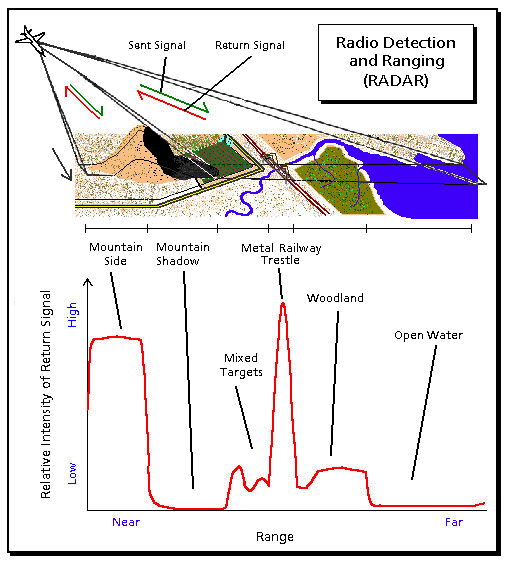
The principle behind radar may sound confusing at first, but a simple experiment can demonstrate the basics. Imagine you are facing the side of a mountain somewhere in the distance. You have a very accurate stopwatch and 'super hearing' to help you.
Now hold the stopwatch in one hand and start timing as you scream as loudly as you can towards the mountain. Stop timing when you hear the first echo of your voice. You have now become a basic radar unit. Since you know how fast sound travels, you can calculate the distance between you and the mountain by using the elapsed time on the stopwatch.
Radar works on many of the same principles demonstrated in this experiment. Instead of one person screaming, a powerful radio beam is sent out at a specific frequency. When this burst of radio energy strikes a solid object, at least part of that sound wave will be reflected back to the transmitter. This signal may not be very loud, but a sensitive electronic receiver can amplify the sound, much like your 'super hearing'. The transmitter and receiver on a basic radar unit are usually mounted close together, much like your mouth and ears.
By calculating the speed of the radio waves and the time it takes for the signal to bounce off the object and hit the receiver, a radar operator can gauge the distance between himself and the object. Moving the transmitter to different points allows the radar operator to receive multiple returns. All of these individual reflections are combined to estimate the size of the object or objects being struck.
Radar technology has improved considerably since the days of World War II, but the underlying principles are still the same. Calculations about an object's speed and direction are made from the results of transmitter and receiver data. When a radar antenna is seen spinning in place, it is sending out thousands of signals and receiving them just as quickly.
The radio frequencies on modern radar systems are now largely in the microwave range, unlike the shortwave radio frequencies used by the British inventors. Radar jammers use matching frequencies to confuse the receivers looking for authentic ones. Microwave frequencies are much more difficult to jam.
How does a Speed Camera or Radar Gun work?
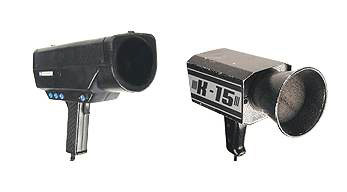
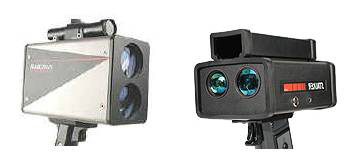 To understand how radar detectors work, you first have to know what they're detecting. The concept of measuring vehicle speed with radar is very simple. A basic speed gun is just a radio transmitter and receiver combined into one unit. A radio transmitter is a device that oscillates an electrical current so the voltage goes up and down at a certain frequency. This electricity generates electromagnetic energy, and when the current is oscillated, the energy travels through the air as an electromagnetic wave. A transmitter also has an amplifier that increases the intensity of the electromagnetic energy and an antenna that broadcasts it into the air. Below are two of the early Radar Guns used in the 1950s - 1970s.
A radio receiver is just the reverse of the transmitter: It picks up electromagnetic waves with an antenna and converts them back into an electrical current. At its heart, this is all radio is -- the transmission of electromagnetic waves through space (see How Radio Works to learn more).
Radar is the use of radio waves to detect and monitor various objects. The simplest function of radar is to tell you how far away an object is. To do this, the radar device emits a concentrated radio wave and listens for any echo. If there is an object in the path of the radio wave, it will reflect some of the electromagnetic energy, and the radio wave will bounce back to the radar device. Radio waves move through the air at a constant speed (the speed of light), so the radar device can calculate how far away the object is based on how long it takes the radio signal to return.
Radar can also be used to measure the speed of an object, due to a phenomenon called Doppler shift. Like sound waves, radio waves have a certain frequency, the number of oscillations per unit of time. When the radar gun and the car are both standing still, the echo will have the same wave frequency as the original signal. Each part of the signal is reflected when it reaches the car, mirroring the original signal exactly.
 But when the car is moving, each part of the radio signal is reflected at a different point in space, which changes the wave pattern. When the car is moving away from the radar gun, the second segment of the signal has to travel a greater distance to reach the car than the first segment of the signal. As you can see in the diagram below, this has the effect of 'stretching out' the wave, or lowering its frequency. If the car is moving toward the radar gun, the second segment of the wave travels a shorter distance than the first segment before being reflected. As a result, the peaks and valleys of the wave get squeezed together: The frequency increases.
 Based on how much the frequency changes, a radar gun can calculate how quickly a car is moving toward it or away from it. If the radar gun is used inside a moving police car, its own movement must also be factored in. For example, if the police car is going 50 miles per hour and the gun detects that the target is moving away at 20 miles per hour, the target must be driving at 70 miles per hour. If the radar gun determines that the target is not moving toward or away from the police car, than the target is driving at exactly 50 miles per hour.
Police officers have been catching speeders this way for more than 50 years. Recently, many police departments have added a new sort of speed detector, one that uses light instead of radio waves. In the next section, we'll see how these cutting edge devices work.
More recently police started using newer laser guns, but they soon proved too unreliable and had limitations and were influences by heat, headlights and other conditions. The basic element in a laser speed gun, also called a LIDAR gun (for light detection and ranging), is concentrated light.
The LIDAR gun clocks the time it takes a burst of infrared light to reach a car, bounce off and return back to the starting point. By multiplying this time by the speed of light, the LIDAR system determines how far away the object is. Unlike traditional police radar, LIDAR does not measure change in wave frequency. Instead, it sends out many infrared laser bursts in a short period of time to collect multiple distances. By comparing these different distance samples, the system can calculate how fast the car is moving. These guns may take several hundred samples in less than half a second, so they are extremely accurate.
Police may use handheld LIDAR systems, just like conventional radar guns, but in many areas, the LIDAR system is completely automated. The gun shines the laser beam at an angle across the road and registers the speed of any car that passes by (the system makes a mathematical adjustment to account for the angle of view).
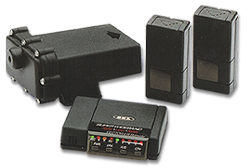 When a speeding car is detected, the system triggers a small camera, which takes a picture of the car's license plate and the driver's face. Since the automated system has collected all of the evidence the police need, the central office simply issues a ticket and sends it to the speeder in the mail.
 We have seen how police use traditional radar as well as new laser technology to catch drivers speeding. As it turns out, conventional radar is relatively easy to detect. The simplest radar detector is just a basic radio receiver, something like the one you use to pick up FM and AM radio stations.
The air is full of radio signals -- they're used for everything from television broadcasts to garage door openers -- so for a receiver to be at all useful, it must pick up only signals in a certain range. The receiver in a radio is designed to pick up signals in the AM and FM frequency spectrum, whereas the receiver in a radar detector is tuned to the frequency range used by police radar guns. Periodically, the frequency range used by the police is expanded, and speedsters everywhere have to invest in new detection equipment.
A basic radar detector won't do you much good if the police officer drives up behind you and turns on the radar gun. The detector will alert you, but by that time, the officer already has all the information he or she needs. In many cases, however, detectors pick up the signal before the speeding car can be tracked. Police often leave their radar guns turned on for a long period of time, instead of activating them after sneaking up behind a car.
Radar guns have a cone or dish-shaped antenna that concentrates the radio signal, but the electromagnetic wave quickly spreads out over a wide area. The radar gun is configured so that it only monitors the speed of a particular target, not everything in the vicinity, so chances are a detector will pick up the radio signal well before the radar gun recognizes the car.
Of course, with this sort of detector, you're relying mostly on the luck of the draw -- if the police officer decides to target you before any other car, you're caught. Modern detectors offer much more extensive protection for speeders, as we'll see in the next section.
A conventional Radar Detector picks up Police Speed Guns using a simple radio receiver and is a completely passive device: It simply recognizes the presence of radar. More sophisticated detectors actually take an active role in eluding the police. In addition to the basic receiver, these devices have their own radio transmitter, which emits a jamming signal. Essentially, the signal replicates the original signal from the police radar gun, but mixes it with additional radio noise. With this information added, the radar receiver gets a confusing echo signal, and the police can't make an accurate speed reading.
Modern detectors may also include a light-sensitive panel that detects the beams from LIDAR guns. These devices are more difficult to evade than traditional radar because the beam is much more focused and it doesn't carry well over long distances. By the time a detector recognizes the presence of the laser beam, the car is most likely in the beam's sights already. Some speeders try to get around these systems by reducing the reflectivity of their car. A black surface reduces reflectivity because it absorbs more light. Drivers can also get special plastic covers that reduce the reflectivity of license plates. These measures reduce the effective range of the LIDAR system, but not the range of the driver's detector. With this extra time, a speeder might be able to slow down.
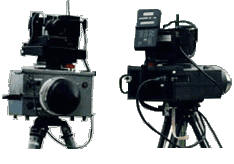 Multanova is a company based in Switzerland who specialise in traffic enforcement systems. They have many products to catch out the unwary motorist, but the ones you ought to know about are the Multanova 6F-2 and 9F - both radar-based systems that can be installed in just about any manner you can imagine, including pole-mounted, box-mounted, mobile, built-in to a vehicle and many others. These people are creative, to say the least. Multanova's products work with off-the-shelf DRS-3 radar units in the Ka band radar - 34.36GHz and are mostly used as mobile traps that can be set up on highway bridges. The 6F-2 systems take 4 or 5 speed readings before taking the photo, and can take up to 3 photos a second using a fast motor drive camera system. The 9F systems extend this capability to being able to determine the vehicle types as either trucks or passenger cars. Both units can be configured either as a front- or rear-facing trap. They are small, and from the front, look like miniature rocket launchers. They are shielded to prevent external interference, and because of the highly targeted radar beam (emitted via a parabolic reflector to allow focussing), are almost entirely undetectable by cheap radar detectors. Therefore a quality and proven detector is required to find the Multanova. Click here to see how the Multanova works. The Multanova camera is the lowest power (output) Portable Speed Camera available and is therefore the most difficult camera to detector. Only the very best and most sensitive Radar Detectors give adequate warning for Multanova cameras. The Multanova was used extensively in Western Australia and is the ideal 'revenue generating camera' as it can take more photographs per hour than all other devices until the Poliscan Speed camera was introduced in July 2011.
 * Source: How Things Work.