
Problems and faults with police radar and police speed guns.
The use of police traffic radar is so widespread that we naturally assume their technology is reliable.
Traffic Radar Reliability
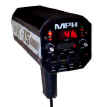 The use of police traffic radar is so widespread that we naturally assume the technology is reliable. After all, if there were questions about radar's accuracy, would the courts process speeding violations with such assembly-line efficiency?
We tend to take the answer to this question on faith. That may be unfortunate, because radar makes mistakes. Lots of them. Some experts estimate that 10-20 percent of all radar-backed speeding tickets are issued in error; and in the case of radar that is operated from a moving police vehicle the number of bad tickets may be as high as 30 percent!
This Brochure {a print version of this info. is available from RADAR) is intended to familiarize the reader with some of the most common radar errors. Our hope is that more people will realize that traffic radar is not infallible, and will challenge speeding tickets they know they don't deserve. The end result will be a greater effort by the radar industry to build better products and by law enforcement to use this technology more responsibly.
Two Kinds of Police Radar
To understand how radar makes mistakes, it is first necessary to know how radar works. Basically, there are two kinds of radar - traffic radar, and rotating- antenna radar. The latter group includes weather, airport, military and other types of commercial radar. By contrast, police traffic radar uses a stationary single antenna that points in a single direction; does not transmit a modulated signal; and does not use a cathode ray screen to display information.
These three differences are extremely important.
All radar works by transmitting a microwave beam on a specific frequency. Targets that are struck by the beam reflect microwave energy to the antenna, a computer analyses any changes in frequency and displays this information. Military-commercial types of radar use a sweeping, modulated beam which provides details about objects' shape, speed, and direction for the operator. By contrast, the stationary beam and digital readout of police traffic radar yield only one piece of information: how fast a target is approaching or receding from the radar.
Police traffic radar doesn't tell its operator which object it is measuring or the direction that the object is travelling, limitations that compel manufacturers to build in certain electronic compromises.
Police Radar Gone Bad
In early 1979, a US television station showed viewers a radar gun clocking a palm tree at 138km/h and a house at 45km/h. In the first instance, the reading was caused by panning the radar antenna and in the second, the radar unit was measuring the fan motor in the patrol car. The TV report prompted a court case that brought radar errors national attention.
A year later the National Bureau of Standards tested the six most popular police radar models, finding that all produced false speed readings in the presence of CB or police radios. Each of the two-piece units produced panning errors like the one that caught the Miami house apparently moving at 45km/h. All of the moving radar units were subject to 'shadowing,' causing some of the patrol car's speed to be added to that of the target vehicle (Federal Register, Vol. 46, No. 5, Jan. 8, 1981).
When the International Association of Chiefs of Police tested 24 radar models in 1983 and '84, the results showed that nearly all of the units were affected by temperature variation, five failed accuracy tests, four had unacceptably wide beam widths and three tended to provide inaccurate readings due to nearby police or CB radios.
Federal performance standards were proposed but never adopted during the Reagan administration. Instead, radar manufacturers promised to police their own ranks. From our perspective, things haven't improved. Police radar is as error prone today as ever, particularly with the widespread use of radar in the instant-on mode.
And the effectiveness of the manufacturers' self-policing policy came to light recently (3/89) when it was revealed that one radar maker sold thousands of units bearing fraudulent Federal Communications Commission certification.
Some of radar's shortcomings are readily apparent. Beam Width is one. Think of a radar beam as a cone - narrow at the radar antenna and widening as it heads for the horizon. Even the narrowest of radar beams - 11 degrees - is 12 metres wide when 60metres down the road and 17 metres wide at 91 metres away. Some radar units transmit a beam as wide as 24 degrees. By the time a radar beam is several hundred metres from a patrol car, the microwaves are blanketing an area as wide as an expressway.
Now picture that expressway full of cars and trucks, and remember that traffic radar can't tell its operator which vehicle it is monitoring, or whether the target is approaching or travelling away from the police car. You quickly understand how great the potential is for misidentification.
Let's throw in another twist or two. Even though police radar is based on the Doppler Principle, most units do not interpret the Doppler shift itself. Rather, they process the frequency of the signal and use its analogy to represent target speeds. Known as phase-lock loop, or PPL, this processing can lock onto the wrong target, double or triple low speed readings, or produce 'ghost' readings. Other types of common radar errors are:
1. Radio or Microwave Interference can come in a variety of forms, both natural and man-made, but they have one thing in common - they produce a false or incorrect reading on the radar unit's display. Common sources of electromagnetic interference include airport radar; microwave transmissions; transmissions of CB, ham, VHF/UHF, and cellular two-way radio/ telephones, including police and business radios; faulty sparkplug wires; mercury vapour and neon lights; high-tension power lines; and high voltage power substations. The radio energy from these sources can overload or confuse the sensitive circuits in a radar gun.
2. Mechanical Interference is any moving object, other than the target vehicle, that can produce a false or incorrect radar reading. The most common sources are vibrating or rotating signs near the roadway; fan blades moving inside or outside the patrol car (air conditioner, heater, defroster or engine fan); another moving vehicle that reflects radar waves better than the target vehicle; and multiple targets in the main radar beam causing multiple reflections of nearly equal strength and making the display read, high, low, or completely blank.
SOURCE: Blind Trust.
Common errors encountered in operating police radar guns
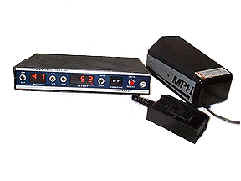 A US state Department of Public Safety produced a comprehensive manual based on the Federal tests. It cautions operators, '...the radar does not generate 'false' readings. Anytime a reading appears, the radar has sensed a signal. The radar operator must be familiar with situations that can produce 'error' readings.' If the operator does not detect the error, a ticket will be wrongfully issued.
Here are the radar 'errors' detailed by the Department of Public Safety's manual:
1. Antenna Positioning Error
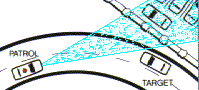
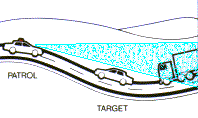
The radar beam travels in a straight line, neither bending around curves nor following the contour of hilly terrain. If the antenna is not properly positioned, it may seem to clock an approaching car when, in fact, it's clocking another car in the background.
2. Look-Past Error
Even if the operator aims his antenna properly, radar is still subject to 'look-past' error. This is caused by the radar looking past a small reflection in the foreground to read a larger reflection behind. This error is all the more insidious because poorly-trained operators assume it can't happen.
The State instructors warn, 'It is a widely-held misconception that the reflected target signal received by the radar antenna will always be that of the closest vehicle to the antenna. There are times, due to traffic conditions, that the closest vehicle is not returning the strongest signal.'
Evidence of the potential size of this error appeared in Car and Driver (October, 1979). The author measured the effective range of Kustom Signals KR11 traffic radar against various vehicles. The typical small sedan did not show up on the radar until it was less than 365 metres away from the antenna, but the same radar unit locked on to a Ford 9000 semi at over 2.3kms away. This shows how common vehicles reflect microwaves differently.
The Texas instructors confirm this problem with radar, saying 'It is not unfair to say that the reading you register could be a larger, better target three-quarters of a mile down the road.'
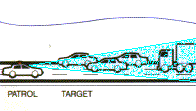
3. Vehicle Interference Error
'Vehicle interference' error occurs when moving radar is used in traffic. For example, traffic ahead can confuse the radar's estimate of patrol speed. Moving radar calculates target speed by subtracting patrol speed from the closing speed of the target. Therefore, anything that produces a low evaluation of patrol speed will automatically result in a high speed reading of target speed.
The state tells its radar operators that this '...situation becomes more critical if difference in patrol speed and interference-vehicle speed is eight to sixteen km/h. A target vehicle moving 98km/h may be recorded at 106 – 114km/h. These borderline speeds are more difficult to detect with the eye.'
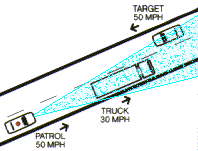
4. Cosine Error
Cosine error produces a result similar to Interference error except no moving traffic need be present. A stationary object adjacent to the road, such as a building, or road machinery, or even a sign, makes a more efficient reflector than horizontal pavement. Therefore the radar uses that reflection as the basis of patrol speed.
If this reflector were positioned straight ahead on a collision path, the patrol speed estimate would be close enough. But the further the object is located off a direct line to the target; the lower will be the estimate of patrol speed. This is a simple trigonometry problem relating to the cosine of the angle between the target and the ground reflector, hence the name Cosine error. Since Cosine error always makes patrol speed seem smaller than it actually is, it always acts to raise the reading of target speed.
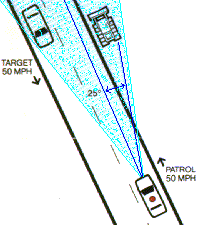
5. Double-Bounce Error
Microwaves are easily reflected. That's what makes radar possible. But the operator must be aware of the difference between an ordinary reflection and a bad bounce. Big objects such as trucks are very efficient reflectors, and it's possible for the radar beam to bounce off several moving trucks at once, always producing erroneous readings.
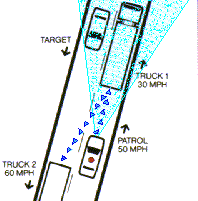
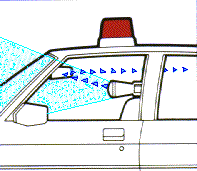
6. Beam-Reflection error
Because microwaves are so readily reflected, the state instructors recommend caution, even in mounting the antenna within the patrol car. They say it's possible that a reflective path can be set up through the rear-view mirror that will produce radar readings on vehicles behind the patrol car when the radar is aimed forward. And those vehicles behind can be either coming or going, since radar does not distinguish directions.
7. Road-sign error
The ready reflectiveness of microwaves means that road signs are also source of errors.
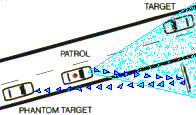
8. Radio-Interference Error
According to the Department of Public Safety course, 'UHF radio now in use can force radar to read various numbers when you transmit, or just key the mike. Citizens band radio transmissions from within the patrol vehicle can cause ghosting (false readings).' It recommends that no radio transmissions be made while clocking target vehicles.
9. Fan-Interference error
When an antenna is mounted inside a patrol car, the Department of Public Safety course says, 'Radar will have a tendency to read the pulse of the fan motor (air conditioner, heater, or demister).' The instructors do go on to say, however, that the fan reading will disappear when a target comes into range, and that the fan will not distort the speed reading of the target car.
However, in the case of moving radar, they say, 'Sometimes a steady fan speed will override patrol car speed reflected from the roadway.' When this happens, the false speed reading produced by the fan will be substituted for patrol speed in the moving radar's calculation of target speed. Since the calculation consists of subtracting patrol speed from closing speed, if the fan reading is less than patrol speed, then the speed displayed for the target will be incorrectly high.